
The lead time on a fragrance quotation is where vegan brands lose launch windows. A quoted 'ten to twelve weeks' is not a delay you accept — it is a schedule you were not shown; the weeks sit in development, packaging, filling and release, and each block is individually controllable. Ask the supplier to break the timeline into stages before signing, and the MOQ conversation finally ends with a date you can plan around instead of a hope.
Key takeaways
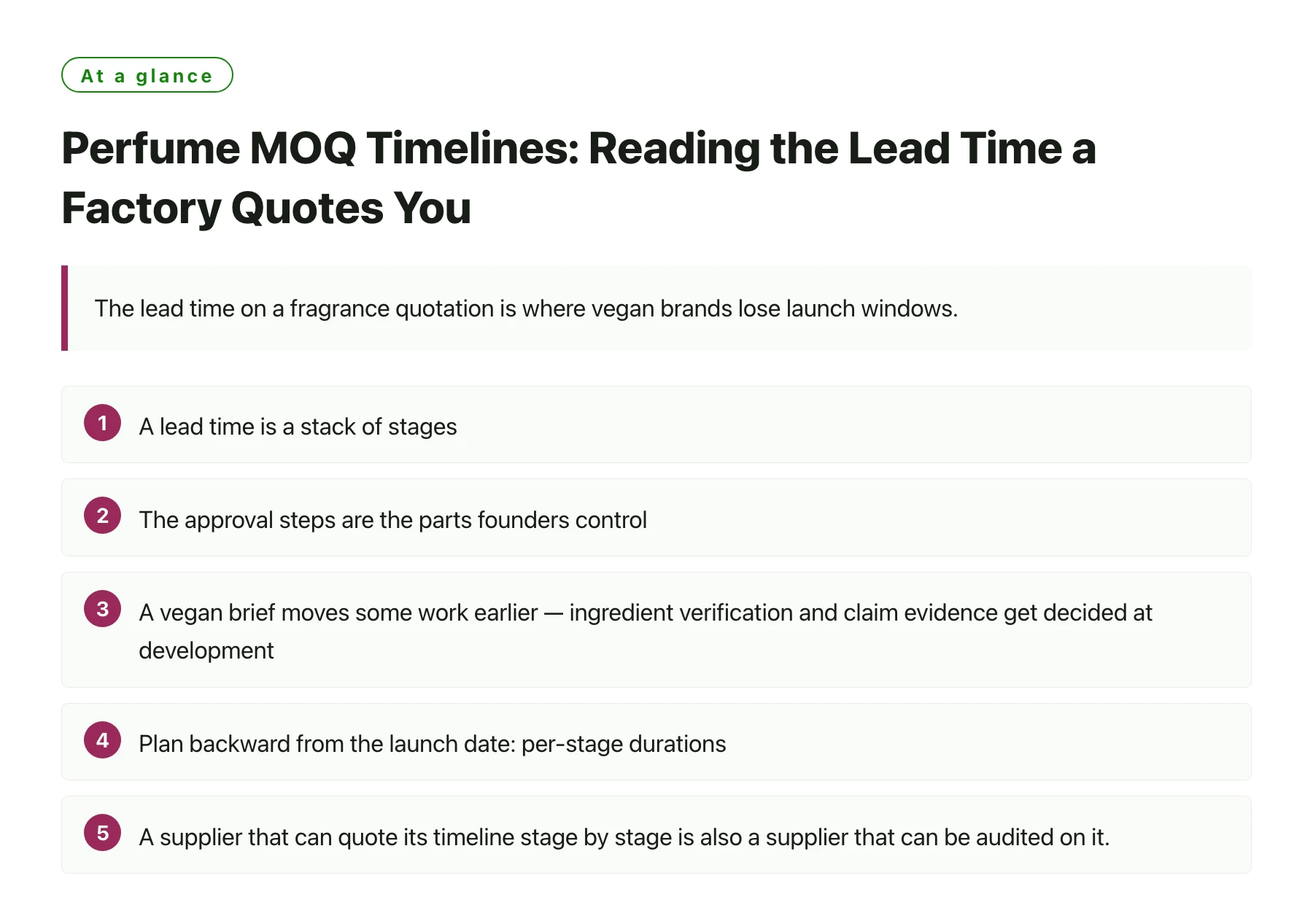
- A lead time is a stack of stages, not a single number; the quoted weeks hide development, packaging, filling and release behind one figure.
- The approval steps are the parts founders control, and delays there push every later stage because the calendar does not compress.
- A vegan brief moves some work earlier — ingredient verification and claim evidence get decided at development, not at release.
- Plan backward from the launch date: per-stage durations, a calendar with buffers, and written confirmation of the dates that matter.
- A supplier that can quote its timeline stage by stage is also a supplier that can be audited on it.
Every fragrance quotation carries a lead time, and almost none of them say anything useful. 'Ten to twelve weeks' tells you the total, not where the risk lives — and the risk is never distributed evenly.
This article maps where the weeks actually go in a first vegan perfume order, how to read a quoted timeline, and how to turn it into a calendar you can launch against.
Where the weeks go
- Brief and development (weeks 1–4)The perfumer works the brief into a formula; a vegan brief adds an early ingredient check so the evidence starts building with the scent.
- Sample rounds (weeks 3–6)Concentrate samples travel, get smelled, and come back with comments. Each round is roughly a week plus transit.
- Packaging and tooling (weeks 4–8)Bottle, cap, carton and print plates; this block runs parallel to development but has its own hard deadline.
- Approvals (weeks 6–9)The concentrate approval and the pack approval. These are the controllable weeks — fast decisions here shorten the whole timeline.
- Production and filling (weeks 8–11)Compounding, filling, labelling and packing the batch that matches the approved sample.
- Release and shipping (weeks 11–13)Batch release testing, the compliance file, and the shipping documents; the vegan evidence pack travels with the goods.
Who controls each block of time
| Stage | What consumes the time | Who controls it |
|---|---|---|
| Development | Perfumer's iteration on the brief | Shared — the brief's clarity decides the speed |
| Sample rounds | Transit and revision cycles | The brand — comment turnaround time |
| Packaging | Tooling and print production | Shared — artwork approval speed matters |
| Approvals | Decision meetings and sign-offs | The brand — mostly |
| Production and filling | Line scheduling and batch size | The factory |
| Release and shipping | Testing scope, documentation, logistics | Shared — document completeness decides it |
Read the last column twice: in a first order the brand controls roughly half the calendar. A founder who blames the factory for a slow first run and then reads the quote stage by stage usually finds the delays in their own approval column.
How to read a quoted lead time
Ask for the timeline in stages and in writing, with the assumptions named: formula complexity, number of sample rounds included, whether packaging runs in parallel, and what counts as 'production ready'. The quoted weeks also have to fit the compliance steps your market requires — in the EU, for example, the notification and labelling obligations sit with the responsible person before or at market entry, so those steps live inside the calendar, not after it [1]. Refuse the single-number answer: a manufacturer that quotes 'weeks' without stages is quoting a guess, and a guess cannot be managed.
Anything described as a guarantee in a timeline deserves suspicion: fragrance development sits inside a regulatory and safety framework where review steps exist for a reason. Bodies like IFRA describe the industry's safety framework applied during development, and that review time is part of the timeline, not a defect in it [2].
A honest reading also separates the vegan-specific weeks. The claim evidence is assembled at development and checked at release; if the supplier quotes the same timeline for a vegan line as for an off-the-shelf base, ask which stage absorbed the verification, because somebody is doing that work somewhere.
A manufacturer that builds custom scents treats the first order as a development project, so its timeline will be longer than a white-label quote — that is the process, not a delay, and it is worth understanding before comparing quotes a manufacturer that builds custom scents.
Planning the calendar backward
Once the stages are named, plan backward from the launch date: research date, marketing date, stock arrival date, release and shipping, production, approvals, and finally the brief. Each step gets a date and a buffer, and the buffers go at the approvals, not at the factory.
The mode of production also changes the timeline you should expect: a manufacturer that supports OEM and ODM will quote two different calendars for the same order depending on who develops the scent, because OEM shifts the development weeks to the brand's side. Ask which lane the quotation assumes before comparing it with another supplier's number.
Before signing, confirm the stage breakdown against the supplier's own published description of what it does — a manufacturer's site, such as www.xuelei.com/, usually states the service scope that determines the stages, which makes the quoted timeline checkable rather than trust-based.
The timeline rule that survives every project: never sign a lead time that you cannot read back. If the quotation says totalling weeks without stages, send it back with the stages from the table above and ask for a number per stage. The supplier who can fill it in is the supplier who can hit it.
Sources
- European Commission: Cosmetics in the EU —— The European Commission's overview of EU cosmetics rules, including the responsible person, product information file and safety report requirements.
- International Fragrance Association (IFRA) —— IFRA is the global trade association of the fragrance industry; its site publishes the IFRA Standards, positions and science on the safe use of fragrance materials.
Frequently asked questions
Why is my vegan perfume order slower than a conventional one?
Usually because of verification work at two points: ingredient and supplier checks at development, and claim evidence at release. Both are front-loaded in a well-run project; if the supplier quotes identical timelines, ask where the verification weeks went.
Can I shorten the lead time by ordering a bigger batch?
Sometimes, marginally — a larger batch can fill line time more efficiently and move the production slot. The big wins are elsewhere: deciding approvals fast and freezing the pack design early. Order size moves weeks at most; approvals move months.
What is the typical total lead time for a first vegan perfume order?
Roughly ten to fourteen weeks from brief to shipped carton for a modest line with standard packaging, and longer with custom tooling or several sample rounds. The range matters less than the breakdown; ask for the stages and compare those.
When should I start the compliance file in the timeline?
At the brief. Ingredient declarations and the vegan evidence chain are built during development, not after production. Starting the file late is the single most common way a launch date slips after the factory has already finished its work.
What buffer should I plan for a first order?
Add two to three weeks on top of the quoted timeline for a first order, and put the buffer at the approval stages where you control the calendar. After the second order, when the process is proven, shrink the buffer to one week.