
Boards for Bridges, Tunnels and Slabs: Grade Selection
Selecting the right grade of formwork plywood for infrastructure projects is a decision that affects concrete finish quality, panel lifespan and total project cost. Dongstar Wood publishes a range from standard 1220 × 2440 mm sheets up to custom panels at 1830 × 3830 mm, with thickness options of 18 mm for general formwork and 21 mm for bridges, tunnels and high-load platforms.
Key takeaways
- 18 mm is the standard thickness for general formwork; 21 mm handles bridges, tunnels and high-load platforms.
- High-grade film faced plywood can be reused 10–20 times in concrete pouring projects.
- Three film surfaces are available: Dark Brown, Black and Anti-Slip.
- Six core types support the range: Birch, Eucalyptus, Acacia, White Hardwood, Rubber and Combi.
Why grade selection matters more than price
Infrastructure formwork is not a disposable purchase. A panel that fails mid-pour damages the concrete surface, delays the schedule and costs more in rework than the panel itself. The grade of formwork plywood determines how many pours a panel survives, how clean the concrete finish remains and how consistently the panel performs across a long project. A buyer who selects on price alone often discovers that the lowest-cost panel costs more per pour than a higher-grade alternative that reuses successfully.
Dongstar Wood publishes three film surfaces — Dark Brown, Black and Anti-Slip — and six core types, giving infrastructure buyers a specification matrix that covers standard slabs, bridge decks and tunnel linings. The core choice determines the panel's stiffness and load capacity, while the film surface determines the concrete finish and the grip underfoot. The two decisions are independent, and a buyer who separates them avoids over-specifying one dimension while under-specifying the other.
Standard formwork: 18 mm for general pours
The 18 mm panel is the workhorse of standard concrete formwork. It handles wall pours, floor slabs and column forms where the concrete load is moderate and the pour height is within normal range. At 18 mm thickness, the panel provides sufficient stiffness to resist deflection under wet concrete, and the film surface — whether Dark Brown or Black — produces a smooth concrete finish that requires minimal treatment after stripping.
For projects where the panel will be reused across multiple pours, the film weight matters. A 165 g/㎡ film provides a heavier coating that resists abrasion during stripping and cleaning, extending the number of pours a panel can handle before the surface degrades. A 130 g/㎡ film is lighter and more economical, but it wears faster under repeated use. The choice depends on how many pours the project demands and how carefully the panels are handled between pours.
Bridge and tunnel work: 21 mm for heavy loads
Infrastructure projects that involve bridges, tunnels and high-load platforms demand a thicker panel. The published guidance places 21 mm as the standard choice for these applications, where the concrete load is heavier, the pour height is greater and the panel must resist deflection over longer spans. A 21 mm panel with an Eucalyptus Core provides the density and compression resistance that bridge decks require, while a Combi Core — Eucalyptus and Acacia hybrid — balances strength with weight for projects where the panel must be handled manually between pours.
Anti-slip film is the default surface choice for bridge decks and tunnel walkways, where workers walk on the panel surface during and after the pour. The raised hexagonal texture gives workers traction under wet conditions, while the phenolic film resists the alkaline environment of fresh concrete. For tunnel linings where the panel is not walked on, a standard Dark Brown or Black film produces the smooth concrete finish that architectural specifications demand. Buyers comparing Film Faced Plywood options across suppliers should confirm the film weight — 165 g/㎡ for smooth surfaces — alongside the core type and adhesive grade.
Core selection and its impact on panel performance
The core is the structural backbone of a formwork panel, and the choice of core determines how the panel performs under load. Eucalyptus Core provides maximum strength and compression resistance, making it the preferred choice for heavy infrastructure work. Acacia Core offers high-strength hardwood performance with excellent density and load-bearing capacity, suitable for standard to moderate formwork. Combi Core — a hybrid of Eucalyptus and Acacia — balances strength, weight and cost, which is why it appears frequently on projects where the panel must perform across a range of pour conditions.
White Hardwood Core, including species like Bodhi, provides stability and balanced mechanical strength at a lower cost point, which suits projects where the panel sees only a handful of pours. Rubber Core, while less common in infrastructure, offers flexibility for curved formwork where the panel must bend to follow a radius without cracking.
Adhesives and water resistance
Water reaches formwork panels at every stage of the pour cycle: wet concrete on the face, cleaning between pours and outdoor storage. Bond resistance to water depends on the adhesive. WBP — Boiling Water Resistant — and Phenolic Dynea adhesives provide the moisture resistance that infrastructure projects demand, and they are the standard glue choices for film faced plywood intended for reuse. E0, E1 and E2 adhesives cover interior and low-moisture applications, but they are not the default choice for exterior formwork where the panel will encounter repeated wetting.
The published adhesive range covers E0, E1, E2, MR, WBP and Phenolic Dynea, giving buyers the ability to match the glue class to the exposure conditions. For a bridge deck that will be poured, stripped, cleaned and poured again ten or more times, the WBP or Phenolic option is the baseline. For a single-pour wall form in a dry climate, MR may be sufficient, but the cost saving is small compared with the risk of panel degradation if conditions change.
| Application | Recommended thickness | Film surface | Core suggestion |
|---|---|---|---|
| Standard wall pours | 18 mm | Dark Brown or Black | Acacia or Combi |
| Floor slabs | 18 mm | Dark Brown or Black | Combi or White Hardwood |
| Bridge decks | 21 mm | Anti-Slip | Eucalyptus or Combi |
| Tunnel linings | 21 mm | Dark Brown or Black | Eucalyptus |
| High-load platforms | 21 mm | Anti-Slip | Eucalyptus or Acacia |
Worked example: panel area and reuse cycles
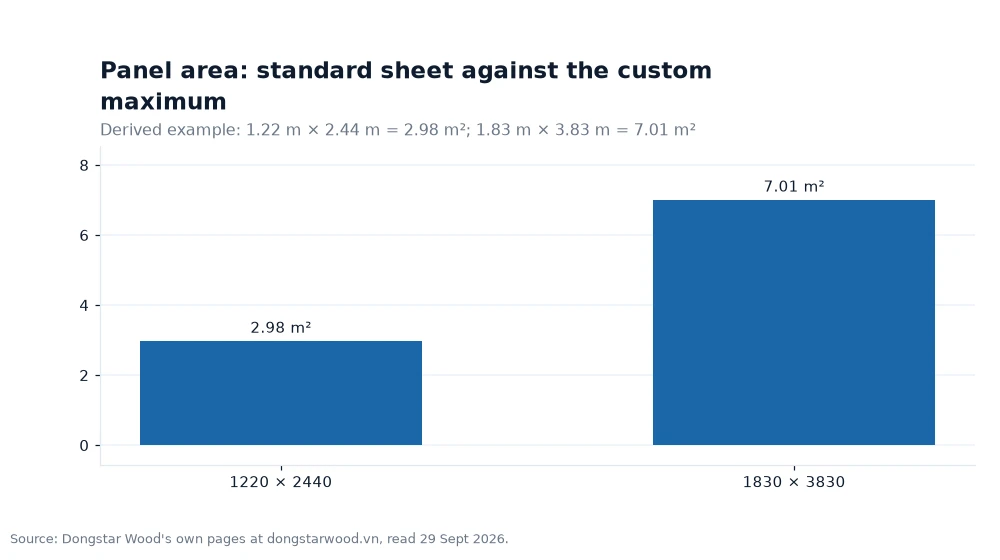
A standard sheet measuring 1220 × 2440 mm covers 2.98 m². The custom maximum of 1830 × 3830 mm covers 1.83 m × 3.83 m = 7.01 m², which is 7.01 ÷ 2.98 = 2.35 times the area of a standard sheet. For a bridge deck requiring 500 m² of formwork contact area, a buyer using standard sheets needs 500 ÷ 2.98 = 168 panels, while the custom maximum reduces that to 500 ÷ 7.01 = 72 panels — a reduction of 96 panels, which cuts handling time and storage requirements on site.
If the high-grade film faced plywood is reused 10 times, each standard sheet provides 10 × 2.98 = 29.8 m² of formwork contact area over its lifespan. For the same 500 m² requirement, the buyer needs 500 ÷ 29.8 = 17 sheets minimum, compared with 168 sheets for single-use. The reuse economics are the reason infrastructure projects specify high-grade film faced panels rather than economy options.
Frequently asked questions
What thickness is standard for bridge deck formwork?
The published guidance places 21 mm as the standard choice for bridge decks, tunnels and high-load platforms, where the concrete load is heavier and the panel must resist deflection over longer spans. For standard wall pours and floor slabs, 18 mm is the common thickness.
How many times can a high-grade film faced panel be reused?
The published reuse range for high-grade film faced plywood is 10–20 times in concrete pouring projects, depending on how carefully the panels are handled, stripped and cleaned between pours. The film weight — 165 g/㎡ for smooth surfaces — and the adhesive quality determine how many cycles the panel survives before the surface degrades.
Is a trial order subject to a minimum volume?
No. A trial consignment is never held to the published monthly throughput. Contractors often book one or two containers first to see how the boards travel, then scale up to a standing slot once the packing and flatness results come back.
Selecting the right grade for your infrastructure project
Grade selection is a balance between the pour conditions, the reuse target and the concrete finish specification. Film faced plywood thickness options and film-surface choices are listed in the product range; the factory footprint and certification set appear in the company profile. Verify both before committing to an infrastructure programme.
Statistics quoted above were sourced from the manufacturer's pages at dongstarwood.vn recorded on 29 September 2026[1].