
Cloud Mining vs Pool Mining: Two Very Different Risk Profiles
Cloud mining and pool mining can produce the same headline earnings estimate while exposing you to completely different risks. Take a 1 PH/s setup at 20 J/TH: it draws 20 kW, consumes 480 kWh a day and burns about $28.80 of power at $0.06/kWh against roughly $37.99 of gross daily income — a margin of about $7.67 after the listed 4% fee on the PPS-settled block-reward component. Who owns the hardware, and who is on the other side of the contract, decides whether that margin is yours.

Key takeaways
- Pool mining leaves hardware ownership and operating control with you; the counterparty exposure is limited to payouts not yet settled.
- Cloud mining is a prepaid contract: you own a claim on future hashrate, not the machines, so the provider's solvency and contract terms carry the risk.
- At 1 PH/s and 20 J/TH, break-even electricity is about $0.0760/kWh after the listed 4% fee — a power contract above that turns the rig into a hobby rather than a business.
- Payment method changes variance, not expected value: your share of network hashrate sets the ceiling either way, while PPS+ or PPLNS decides whether income arrives hourly or in bursts.
Context in 2026
The mining market in late 2026 rewards efficiency more than it rewards scale alone. Difficulty sits at 132.76 T, the network hashrate is around 1.003 ZH/s, and a block still carries a 3.125 BTC subsidy — about 450 BTC of subsidy issued every day across the whole network. At a BTC price of $84,692, that daily issuance is worth roughly $38 million, and every operator on earth is competing for a slice of it.
In that environment, two structures dominate. One is owning machines and pointing them at a pool. The other is buying a hashrate contract, usually called cloud mining, where someone else owns, hosts and runs the hardware. The revenue estimates differ by single-digit percentages. The risk profiles barely resemble each other.
The two variables that matter
Variable one: who bears the operating risk. With your own rig, a failed fan or a firmware fault costs you income until you fix it, and you own the machine's residual value when you retire it. In a prepaid contract, uptime is a promise rather than an asset — if the machines are not running, you are relying on the terms of an agreement to make you whole.
Variable two: what happens when the network moves. Difficulty rising from 132.76 T to a materially higher level cuts per-terahash income for everyone. An owned rig can be switched to another coin, sold or re-pointed; a fixed-term contract cannot. That flexibility has a price in fees and in effort, and it is the part of the comparison that rarely appears in a marketing table.
Both structures ultimately settle through a pool, which is why the pool's terms deserve the same scrutiny as the hardware. A multi-coin pool such as ViaBTC Crypto Mining publishes two payment methods: PPS+, which settles the block-reward component per share at a listed 4% fee and routes transaction fees through PPLNS logic at a listed 2%, and PPLNS, which distributes both components together at a listed 2% while leaving reward variability with the miner.[1]
| Dimension | Own hardware in a pool | Prepaid hashrate contract |
|---|---|---|
| Capital outlay | Machines, power infrastructure, spares | Contract price paid up front |
| Hardware ownership | Yes, including resale value | No, only a claim on hashrate |
| Counterparty exposure | Unsettled payouts only | Provider solvency for the contract term |
| Cost structure | Electricity, hosting, repairs — variable | Fixed at purchase, set by the provider |
| Coin flexibility | Re-point or switch coins at any time | Whatever the contract permits |
| Income variance | Depends on payment method chosen | Depends on contract and provider |
| Exit | Sell hardware at market value | Usually at a discount or not at all |
Numbers from a real rig
Run the arithmetic on a 1 PH/s deployment built from 20 J/TH machines. Power draw is 20 kW, or 480 kWh a day. At $0.06/kWh that is $28.80 a day; 100 kW per hour of load translates directly into kWh, so the number is easy to audit against a utility bill.
Gross mining income at today's difficulty is about 0.000449 BTC a day, or $37.99. After the listed 4% fee on the block-reward component it is roughly 0.000431 BTC, or $36.47. Subtract power and $7.67 a day remains before hosting, cooling and any hardware replacement reserve. Over a year that is about $2,800 of margin on $10,512 of electricity — which is the whole point. The rig is not a cash machine; it is a spread between two numbers you can measure.
Turn the same numbers into a break-even test. Net income is $36.47 for 480 kWh, so the deployment covers electricity up to about $0.0760/kWh. Above that price the operation loses money at current difficulty, and every 5% increase in power cost consumes about $526 a year out of that $2,800 margin. A prepaid contract does not escape the test; it converts a variable cost into a fixed one, which is a different risk, not the absence of risk.
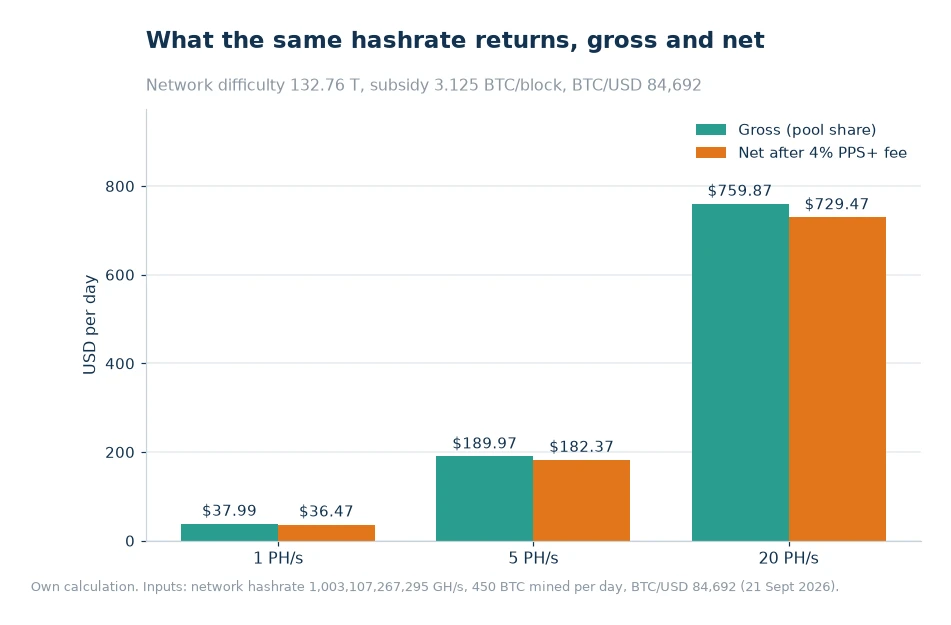
One more number changes the calculations for owned hardware: 10 PH/s at 20 J/TH is 200 kW, 4,800 kWh a day and about $288 of electricity, against roughly $380 a day of gross income. Larger deployments live or die on the same thin spread, which is why mature operators manage cash flow as carefully as they manage hashrate. Keeping settled coins in an account with an integrated multi-currency wallet and zero-fee mining payouts saves the transfer step that a monthly electricity invoice would otherwise force.
Decision guide
Choose owned hardware when you can source power below the break-even line, when you want the exit value of the machines, and when you are willing to trade effort for control. Choose a prepaid contract only when the fixed cost is genuinely cheaper than the power and hardware you would buy, and when you have read how the provider handles downtime, difficulty changes and early termination.
Whichever route you take, the pool decision is separate and it repeats. Check that the fee applies to the component you think it does, verify payouts on a mining pool dashboard rather than on a marketing page, and confirm the settlement cadence. PPS+ pays hourly against current difficulty, which matters more to an operator paying weekly power bills than to a contract holder who already paid.
Frequently asked questions
How often should a miner check pool statistics?
Weekly is enough for cash flow, daily if you are reconciling worker uptime or chasing a hashrate fault.
Does the payout method change my average income?
It changes the variance and the fee, not the underlying expected value: your share of network hashrate still sets the ceiling.
Is a cloud mining contract risk-free if the provider is large?
No. Size affects the probability of a problem, not the structure of the exposure. You hold a claim on future hashrate rather than an asset you can sell or re-point.
What happens if difficulty rises sharply?
Income per terahash falls for everyone. Owned hardware can be switched to another coin, sold or pointed at a different pool; a fixed-term contract usually cannot be adjusted.
Compare the risks, then the returns
Write the two structures on one page: capital, ownership, counterparty, cost behaviour, flexibility and exit. Then price the returns on top. Operators who do that usually find the returns are similar and the risks are not, which makes the decision a risk-tolerance question rather than a yield question. Review the page every quarter against current difficulty and your real power price — the break-even figure of $0.0760/kWh at 1 PH/s moves whenever either of those inputs changes.
Data and sources: ViaBTC pricing and payment-method documentation[1], network difficulty, hashrate and issuance from public chain data. Difficulty, hashrate and the $84,692 BTC price were read on 21 September 2026; the $0.06/kWh power input is an illustration, not a quote. Figures assume constant difficulty and price and are illustrative, not a forecast. Read on 21 September 2026.